Architecture & Functional Logic: Transitioning from Prototype to a Secure Enterprise Architecture

This article is Part 2 of our three-part series.
• Part 1: Rapid AI Prototyping.
• Part 2: Architecture & Planning the Functional Logic.
• Part 3: Production-Ready Code.
In the first phase of this series, we focused on speed, quickly moving from an initial vision to a user-validated functional prototype. Now, IT Architects and CTOs face the critical next step:
How do we responsibly transition this concept into a scalable, production-ready system?
Before engineering teams start generating new code using out-of-the-box AI agents like GitHub Copilot or Claude Code, the architectural and functional frameworks must be strictly defined. The goal is to prepare the environment so that AI-assisted development drastically accelerates output while rigorously adhering to enterprise quality standards.
The Foundation: Standardized Setups and Monorepo Structures
To provide AI agents with optimal context, we rely on a Monorepo structure. While backend, frontend, infrastructure, and OpenAPI specifications remain functionally encapsulated, managing them in a single repository prevents context loss during cross-functional code generation. The agents operate primarily within VS Code and are constrained by a clearly defined enterprise tech stack. In our practical example, this includes Java, Spring Boot, and Maven for the backend, React and TypeScript for the frontend, alongside PostgreSQL.
Setting the Guardrails: Why Business Context is Crucial
No technical decision happens in a vacuum. Whether operating in a greenfield or brownfield environment, teams must navigate existing restrictions, architectural guidelines, security mandates, and accessibility rules. Out-of-the-box AI agents inherently lack this company-specific context.
Our primary architectural task is to translate stakeholder documents and design system manifests into structured formats that AI agents can natively read, search, and apply. Without this intentional system design, teams risk generating unmaintainable "slop" code that works locally but can never survive a transition to production.
AI Primitives: The Modular Building Blocks of Efficient AI Agents
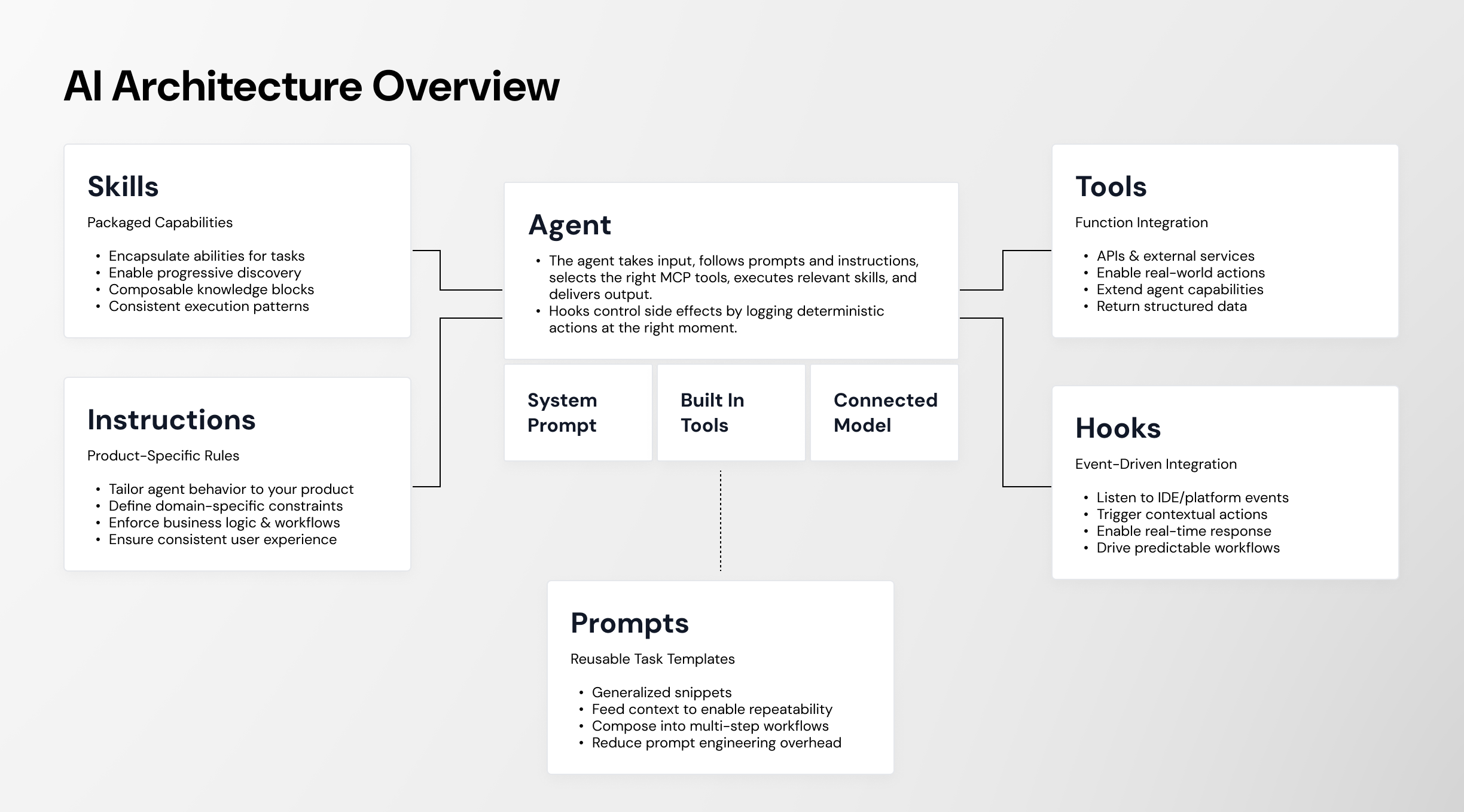
To equip AI agents with the right capabilities and technical context, we use “AI Primitives”. These fundamental building blocks snap together like Lego pieces to form a robust AI system, making generative development truly viable for professional engineering teams:
- Instructions: These are the product-specific guardrails. They embed your business logic and architectural decisions (e.g., package structures, testing guidelines) and force the agent to follow your specific tech stack rules, preventing inherent model biases from bleeding into the codebase.
- Prompts: Reusable task templates. Instead of rewriting instructions from scratch, we use standardized prompts (e.g., for generating API endpoints or unit tests) that apply domain rules flexibly and reduce redundant work.
- Tools & MCP (Model Context Protocol): Agents must interact with the real world—reading IDE files, fetching external APIs, or verifying infrastructure. We utilize the Model Context Protocol (MCP) as the standardized technical bridge for tool integration. Through MCP, agents can autonomously establish a read-only connection to PostgreSQL, pull design tokens directly from Figma, or seamlessly trigger QA tools like ESLint, Playwright, and Terraform.
- Skills: We encapsulate complex, recurring engineering tasks into skills. A skill provides detailed rules and best practices—such as executing front-end design systems or generating unit tests—allowing the agent to dynamically pull the right capability exactly when needed.
- Hooks: Hooks act as event integrations or background middleware. They don't teach the agent anything new; they listen for lifecycle events. A non-negotiable use case for security and compliance teams is the automated Security Audit Log, which quietly records exactly what tool the agent invoked and when. Hooks can also be used to automatically trigger documentation updates after a code change.
From Handover to a Centralized Engineering Workflow
Through this rigorous structuring, abstract requirements become a documented, machine-readable infrastructure. The development phase kicks off with a seamless handover: the validated prototype is pushed as a structured codebase into a repository. To ensure enterprise-wide scalability, we centralize these fully configured agents and primitives in private repositories (e.g., GitHub.private) or potentially via an Agent Package Manager (APM). This guarantees that the entire engineering organization accesses the same secure, standardized AI assistants, eliminating the risks of developers writing isolated, rogue prompts.
Conclusion & Next Steps
Implementing this AI architecture separates fleeting prototypes from maintainable, scalable production systems. By equipping our AI agents with the proper tools and architectural guardrails, we empower engineering teams to achieve maximum velocity without compromising on code quality.
In the third and final instalment of this series, our CTO Florian Aßmus will demonstrate how to actively apply these prepared primitives and agents to generate secure, Production-Ready Code from our validated prototype.



More related topics
Rapid AI Prototyping: From a Vision to Validated Products
Learn how rapid AI prototyping accelerates AI product development by turning business requirements into functional, validated prototypes from day one.
Read More
Azure Arc: Guide to Cloud Migration & Cloud Native App Development
Azure Arc provides tools and capabilities that allow businesses to manage their infrastructures, services, and applications across on-premises, multi-cloud, and edge environments.
Read More